Arguably the most substack-like of my writings yet, as it’s about current trends that all lead to the same verdict. I’ve been going back and forth on whether or not to write or even post this because it feels redundant on my other essays about capitalism’s degradation of human experience. I decided to pull through with it, as this has been on my mind lately, and hopefully someone can find meaning in it.
There's been a few trends that have been popping up on my feed– or micro-trends, since it’s very likely that when I am finished editing and writing this it will already have faded into obscurity. There was a short uptick in pseudo-influencers on Instagram and Tiktok trying to present or transform themselves to be the most interesting, “swag”, and “niche” through adopting behaviors that signal a kind of deep knowledge in music, literature, or internet culture (I call this nichestegram, like a more ironic version of what people have been deeming as “tasteslop”). This attempt at seeming more intriguing by doing everything else except actually going out to read and do interesting things will always fail, and its spotlight will always be cut short due to the transience of the internet, especially in social media spaces.


Similarly, It’s common to see posts or videos of men or women dressing in outfits that are typically incredibly ugly, but show a level of artistic intention that can both be comical and avant garde. I can only assume that this style was inspired off of New York City streetwear or “ugly chic”, where men and women dress in ways that can be seen as mismatched and socially disconnected as a way to show a kind of attractive carelessness and highlight appealing natural features such as a modelesque body or a pretty face. While this may have roots in urban areas where artistic freedom and experimentation is encouraged, it has spread onto the online world where dressing in a weird way has the benefit of attention through views and likes. Though I cannot deny that even if there is a profit incentive, the influencer or the likes may have adopted these kinds of styles out of genuine interest in it's eccentricity and unconventional nature. However even if this interest is real, it feels like developing this style outside of online inspiration seems to be few and far between.


This fashion and lifestyle has a lot of overlapping similarities to a unique blend of humor videos that utilize meta-irony and mimic people who are more clueless or outdated to the typical posting expectations of social media. These comedians try to portray an eclectic inner world or lifestyle that often shocks the viewer by taking advantage of the randomness of the algorithm, where videos are pushed onto the viewer one at a time, where people don’t know what they’re going to be seeing next. Frequently these videos appropriate from their source material with so much attention to detail and earnest effort it teeters between the line of genuine appreciation and its meta-humor. It becomes so accurate in its emulation that it effectively captures the same level of confusion and amusement from the viewer as the post it references from, but the ultimate punchline is rooted in the comedian’s spin on its recreation.


For a time I considered naming this “Surveillance Dadaism” where the word of surveillance is taken from surveillance capitalism, and the dadaist aspect comes from the dada art movement. Where the artists involved would make visual and performance commentary about the meaninglessness and loss of meaning in society during World War I. These artists would utilize randomness, collage, and nonsensical imagery to challenge the viewer’s understanding of art, making them the foundation of the 20th century anti-art movement. Though I wonder if it is even considered dadaist if these comedians make videos with no real intention but to elicit attention on social media compared to a message about the state of human entertainment. As the 20th century Dadaists claimed that art was everything and nothing, the 21st century social media meta-irony can assert that everything can be a punchline, making nothing sacred on the internet and by extension everything that the internet can see. If everything becomes a joke to the viewer through its presentation despite intention, everything can be analyzed and taken seriously.
Ultimately, even if there is no deeper message, it’s unintentional signalling and reflection of our current culture should consider it a kind of Surveillance Dadaism. These are posts that use randomness to aid its execution, and the genuine effort in production value elicits a real reaction from the viewer that can question the state of comedy and its production. Even if the message was unintentional from the comedian, it can still be used to question our culture from the viewer. Without the existence of surveillance capitalism and the online algorithm, this kind of humor would have never existed, and this need for randomness and surprise would have never been in demand.
Even if the art world has more intention in its visual execution and meaning compared to funny videos online it still feels like there is a lack of organizational structure despite visual similarity among Gen Z artists. I have mentioned before in another essay that despite seeing strong visual similarity among Gen Z artists in the fine art field in real life, I can say the issue is even more pervasive online. There is a rise of painting style that blends both the offline consumerist influence that greatly shaped the generation’s childhood, and the online experience shown in contrast that shows a completely different but important world to the artist. These are paintings and mixed media exhibitions that are marked by its capitalistic consumerism, visual juxtapositions, and visual manipulation through stretching the image, jarring colors, and the inclusion of text.
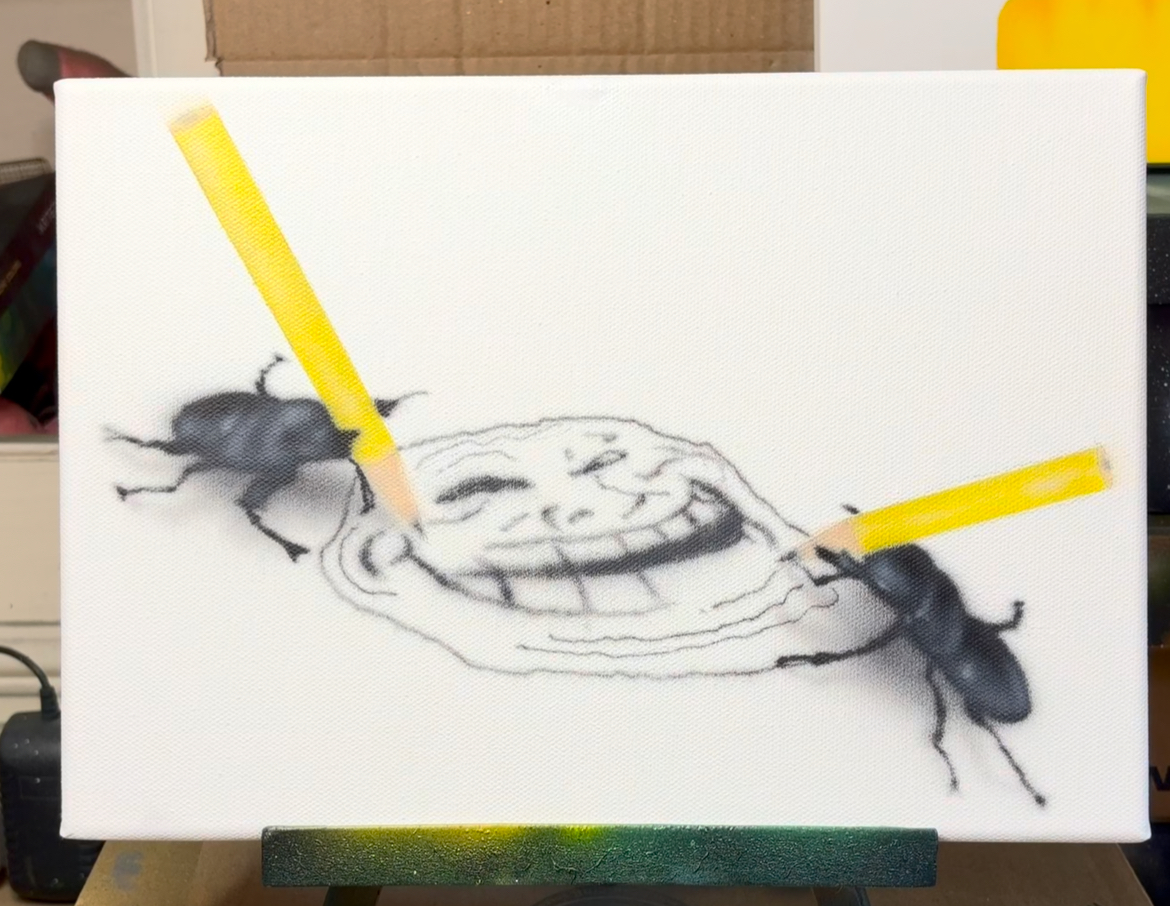
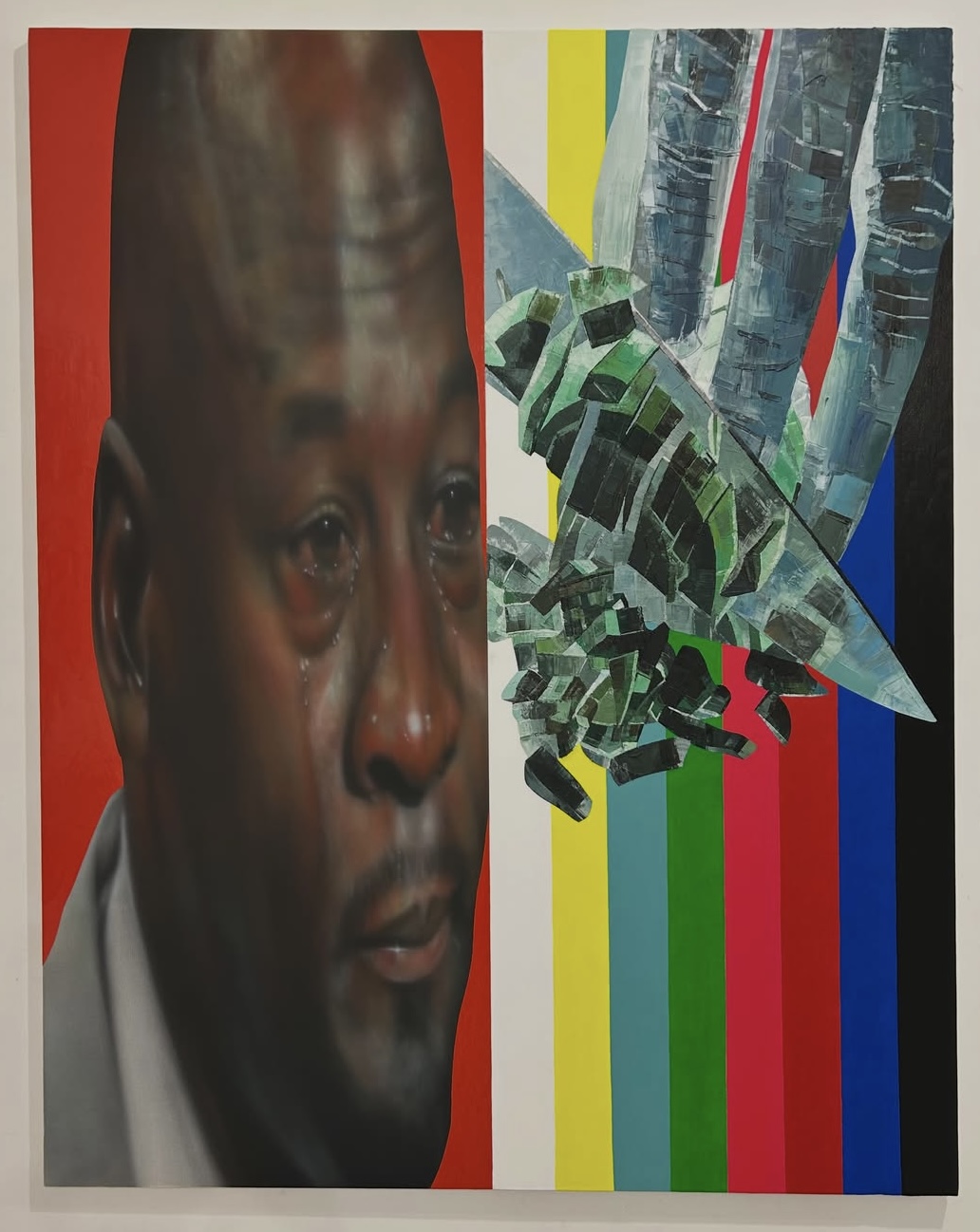
Personally despite begging for art movements, I often found myself disappointed with the clear art movement that was unfolding in front of me. I believe it is a genuine gift to find such visual similarity from all over the United States and even internationally, but a part of me feels like its decentralization despite visual coherency makes it a bit spineless. As the nature of social media makes it infinitely easier to take inspiration and copy from others for one’s own work, it makes it much harder to organize in real life from how far apart each artist is from one another. It also makes it less interesting to me that the visual motifs have such deep inspiration from the online it seems there’s less inspiration about the person’s offline surroundings. Self expression is so tied to the online world that the expression of the self outside of it takes a back seat, which simply isn’t my taste. It gives me fear that such strong imagery and visual foundation lacks so much community that it will be reduced to a trend.
I feel as if all of this commentary is similar to other online commentators about minor worrisome trends that last for a few weeks. And in the end the reporting and discussion all go towards the same conclusion– surveillance capitalism causes people to act in ways inorganic to their own interest but for the sake of garnering attention as the new form of capital. People have been adopting personas in hopes to get attention that can be converted into infamy and monetization on the falsified identity.
Nichestagram is adopting a fake identity to seem more interesting in real life without doing any of the real life experience, but for solely seeming more interesting to post on social media. Expressed through fashion, behaviors, and slang. The rise of Surveillance Dadaist short-form videos are a unique result of the system that awards production based on surprise, references, and imitation. Within the art world, the possibility of an authentic art movement based on visual similarity is stifled due to the decentralized nature of the internet that awards similarity but makes it difficult to organize among the artists that participate in it. These artists use visual language that is tied so deeply to online culture with little to no visual references from their direct surroundings.
It’s the same issue with the same conclusion, really. The real world has been tampered and ruined by the same economic system trying to create a false world that monetizes time. Real world subcultures and experiences have been reduced as identity and community are now found through the lens of media consumption.